


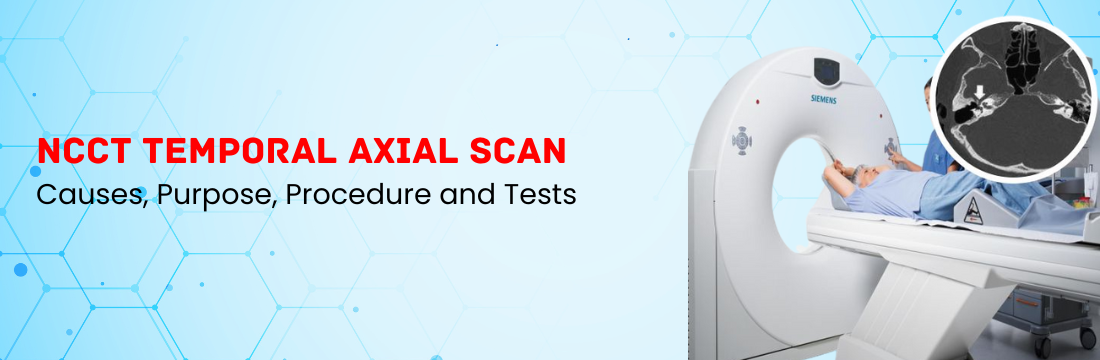
Temporal Axial CT (computed tomography) or CT scan Temporal Axial is non-invasive radiological tool which uses X-rays for the detection of abnormalities in the side and base of skull bones (Temporal Axial).
Temporal Axial CT (computed tomography) or CT scan Temporal Axial is non-invasive radiological tool which uses X-rays for the detection of abnormalities in the side and base of skull bones (Temporal Axial). NCCT Temporal Axial is the procedure that uses X-rays with computer technology to create 3D images of the lower skull behind the ears and used to look for various abnormalities which occurs below the skull around the ears. NCCT images are more detailed and clear than simple X-rays and can help to detect the abnormalities early and easily in temporal area. There are various conditions which can be detected by NCCT Temporal Axial scan these conditions include fractures, injuries, lymphomas, congenital disorders, tumors, ear infections etc.
Temporal Axial NCCT
NCCT Temporal Axial is diagnostic tool like MRI and PET CT. This procedure helps to capture the cross sectional images of the area below part of skull containing ear and other important bones and muscles. Temporal Axial and provides detailed overview of the skull in around and base of the skull. Various abnormalities detected by NCCT Temporal Axial include deformity in the Temporal Axial, injury, fracture of Temporal Axial, congenital abnormalities.
What are the Uses of NCCT Temporal Axial?
- Used to look for the congenital abnormalities in lower part of skull
- To look for traumatic injuries around the ear
- To look for infections in and around ear
- To look for degenerative changes in the lower part of skull
- Fracture in Temporal Axial area
- Injury in Temporal Axial area
- Infection in Temporal Axial area
- Inflammation in and around Temporal Axial area
- Help to detect the stage of cancer in temporal axial area
- Help to look for the effectiveness of treatment in temporal axial area
- Used to evaluate the trauma in Temporal Axial area
- Helps to plan radiotherapy for the Temporal Axial condition area
Axial Abnormality Causes
There are various reasons which can lead to the abnormalities in the Axial and these include:
Tumors
There is the probability of uncontrolled cell division in the axial part leading to the formation of tumors. This abnormality can be detected by CT Axial and effective tool for diagnosis.
Dislocation
Dislocation in Axial bone leads to the axial abnormality by dislocating the axial bone and is one of the main causes to go for CT Axial. Axial joint is combination of more than one bone and the joint is complex in various ways. Bone dislocation is displacement of axial bone from their original position or from joint sockets of Axial.
Arthritis
This condition is also very recognized cause of the axial abnormalities which needs CT scan of Axial. Arthritis is condition very much recognized with bone conditions and Axial joint conditions are no different.
Inflammation
This condition can make it difficult for a person to listen and pain in lower part of head. This also makes it difficult for a person to run and effect daily functioning of person.
Fracture
Fracture can be broken bones, joints or ligaments which are responsible for the attachment of axial bone. Bone fractures and joint fractures are reason for various types of axial abnormalities. Fractures are of different types and axial fracture can be minute like wall crack or total breaking of bones within the Axial joint. The later condition is serious and needs immediate treatment.
Injury
Injury can be due to anything like accidents, fighting, hitting with some solid material which can result axial injury and its associated tissues and bones. Injuries can be minor or major related to Axial and both can interrupt the normal functioning of Axial.
Temporal Axial CT with contrast (CECT Temporal Axial)
Temporal Axial CT is the advanced procedure of the simple CT Temporal Axial. In contrast CT, iodine based contrast is used for the detection of abnormalities in the Temporal Axial. Contrast used CT procedure give more clear images of Temporal Axial and helps to generate images with more clarity. This helps in easy and early detection of Temporal Axial abnormalities for effective and early treatment.
Which Tests Are Used to Check for the Temporal Axial Abnormalities?
There are various types of tests used to check for Temporal Axial abnormalities and these include:
- NCCT Temporal Axial and Coronal (Book Now)
- HRCT Temporal Axial (Book Now)
- NCCT Temporal Axial (Book Now)
- CECT Temporal Axial and Coronal (Book Now)
Conclusion
Temporal Axial NCCT (computed tomography) is the diagnostic tool used for the detection of abnormalities in the Temporal Axial which includes from the injury and fracture in Temporal Axial and surrounding areas. There are various uses of temporal NCCT like detection of tumor, congenital abnormalities, inflammation, trauma in the Temporal Axial etc. NCCT Temporal Axial uses X-rays with computer technology and takes the pictures at various angles for clarity and with more description to get the condition of Temporal Axial easily detected. NCCT Temporal Axial is also done with the contrast material, this is also called CENCCT Temporal Axial or contrast enhanced computed tomography.
Frequently Asked Questions (FAQ)
What is NCCT Temporal Axial scan?
NCCT Temporal Axial scan is non contrast computed tomography used to look for temporal axial abnormalities.
What is difference between NCCT and CECT Temporal Axial?
NCCT Temporal Axial is non contrast diagnostic technique while as CECT uses contrast material for diagnosis of temporal abnormalities.
Is NCCT temporal Axial scan able to recognize fracture in shoulder blade?
Yes, NCCT temporal axial can detect fracture in shoulder.
What are the different causes of temporal axial abnormalities?
Various causes of temporal axial disorders include injury, infection, inflammation, dislocation etc.
List out some symptoms caused due to temporal axial diseases?
There are various symptoms related to temporal axial abnormalities and these include pain in shoulder, not able to move shoulder, shoulder pain in back side etc.
Where is NCCT Temporal Axial Centre near me in Delhi?
Patient can visit Ganesh Diagnostic Imaging Centre for NCCT Temporal Axial scan with heavy discounts. For more information and appointment, click here.