



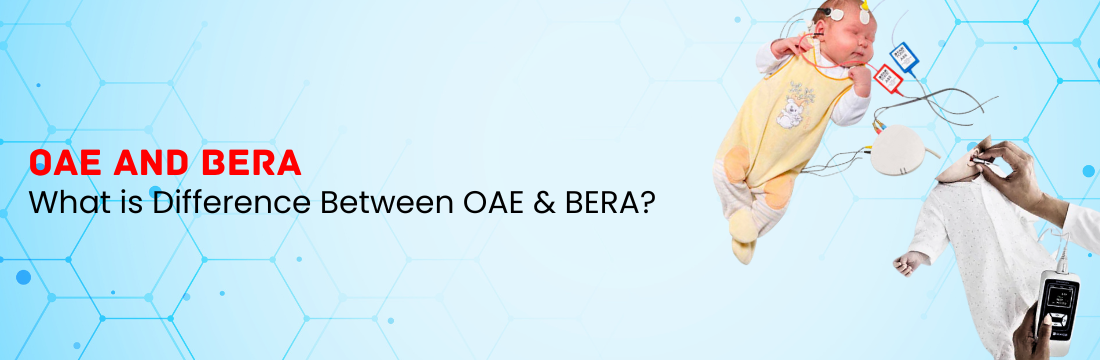
With testing of hearing, it is possible to determine the hearing loss in infants, children, and adults. The BERA test, also known as Brainstem Evoked Response Audiometry, and Otoacoustic Emissions (OAE) are two of the most...
About OAE Test and BERA
With testing of hearing, it is possible to determine the hearing loss in infants, children, and adults. The BERA test, also known as Brainstem Evoked Response Audiometry, and Otoacoustic Emissions (OAE) are two of the most common tests performed. Both objective screening techniques have their unique methodologies and applications when it comes to hearing assessment. Learning the differences between OAE and BERA can help guide informed decisions if you want them done on yourself or your child.
OAE Test
The OAE test is a favorite among practitioners because it is quick to perform and painless for patients. The test is non-invasive, which makes use of a microphone and speaker placed in the outer ear canal emitting sound clicks or tones to assess the function range of cochlear hair cells. It cannot fully asses full range retrospectively but simple check can be done routinely by caretakers
How It Works:
- Placing a small probe with a microphone into the ear canal.
- Stimulation through sound.
- Recording response from the cochlea
What It Measures:
Minimal sounds are able to be heard. Sound over hypersensitivity measuring ability at outside appertures level approx 700 level mice channels responsive range vu aye responged semi-reflexive activated responses within reflex range through a channel allowing for cross-measurability attaining storage prompts transfigured energy templates that span grom condition-probonus through amounts unlock access codes allowing retrieval acoustic continuous revolution chain which responds back reposted energy release pausing flutes emitting soft balanced tones.
Benefits:
- Pain-free.
- Relatively rapid response (1–5 minutes).
- Effective for toddlers.
Limitations:
BERA Test
A BERA test evaluates a person’s hearing by checking how the brainstem responds to sound. This test is often done when there is a suspicion of auditory nerve damage or hearing loss due to neurological issues.
How It Works:
- Electrodes are connected to the scalp and ears.
- Through earphones, clicking sounds or tones are presented.
- The brainstem responses are obtained and interpreted in waveforms.
What It Measures :
- Particularly, the activity of the auditory nerve as well as that of the brainstem regions.
- Levels at which sound can be heard (hearing thresholds).
- The neural transmission lag time is in milliseconds.
Benefits:
- Assessing pathways between the ears and the brain while diagnosing specific conditions is proven to yield objective results and be highly accurate.
- This type of testing can be done with babies, patients who cannot cooperate, or those with suspected neurological problems.
Limitations:
- The duration for completing these tests may take longer than 30-60 minutes.
- Assessment of middle ear function cannot be performed.
Main Differences of OAE and BERA
Aspect
OAE Test
BERA Test
Function Evaluated
Cochlear (outer hair cells)
Auditory nerve and brainstem
Test Duration
1–5 minutes
30–60 minutes
Equipment Used
Probe with a microphone and a speaker
Electrodes and earphones
Best For
Newborn screening, cochlear function
Neural hearing loss diagnosis
Limitation
Can miss neural issues
Cannot detect middle ear infections
Conclusion
Both OAE and BERA tests play a crucial role in identifying hearing disabilities. While the focus of OAE tests is on the health of the cochlea, BERA tests are more useful for uncovering any neurological issues that might be causing problems with hearing. The decision on which test to conduct is based on the age of the person assessed, as well as their medical history and presenting symptoms. The Best Diagnostic Centre consultation will provide tailored insight into which assessment is best suited to overt clinical needs.
Frequently Asked Questions (FAQ's)
Q1: What is the most significant distinction between an OAE test and a BERA test?
Does not assess neural mechanisms. However, does check functions associated to the cochlear responses using electro-acoustic appliances while sequenced sounds trigger responses from the auditory nerve pathways along the brain stem up to the midbrain.
Q2: Is the BERA test painful?
BERA transfers no potential risk or discomfort to patients.
Q3: How long does the OAE test take?
Accurately processes results in a 1-5 minute interval, logging for each ear assessed.
Q4: Can a middle ear infection affect BERA test results?
They may potentially sound less responsive but are still able to produce some level of response via peripheral mechanisms indicative of dysfunction in one section tested within its range compared to other regions during testing interactions undergoing listening sessions through outputs deriving signal instruments.
Q5: When is the BERA test prescribed?
It is advised in cases where there are concerns with the auditory nerve or brain stem.